
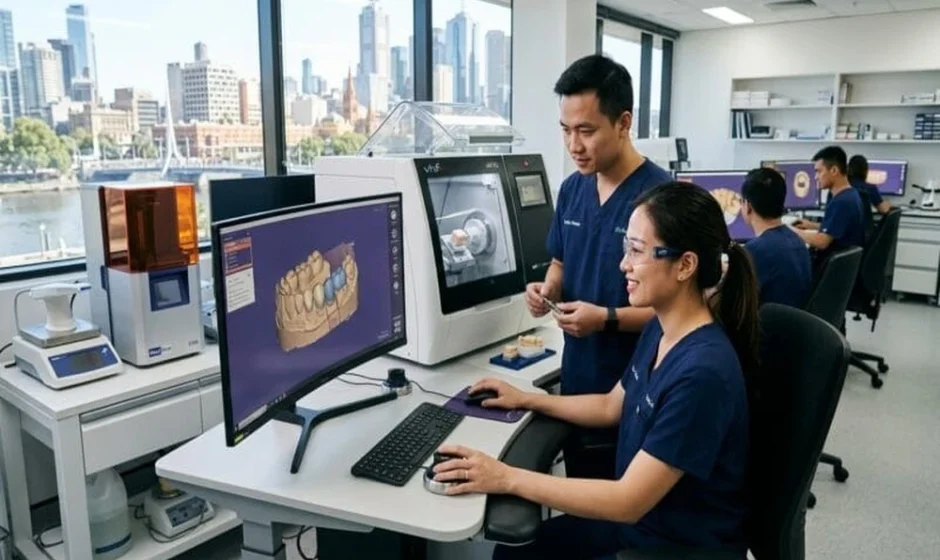

If your dentist has ever mentioned that your crown is being “designed digitally,” you might have wondered who is actually doing the designing. The answer is often a digital dental design lab, a team that works entirely on screen rather than at a bench full of plaster and wax.
The idea is simple. Your dentist scans your teeth, either with a handheld intraoral scanner or from a traditional impression, and sends the digital file to the design team. Using specialized CAD software, a technician builds the restoration virtually: shaping the surface of a crown, setting how it touches neighboring teeth, and checking the fit against your bite. Only when the design is approved does anything get milled or printed.
This approach has a few clear advantages. Designs can be reviewed and adjusted as many times as needed without wasting material. Files travel instantly, so there is no waiting on couriers just to begin the work. And because everything is stored digitally, a case can be revisited later if something needs to be reproduced or refined.
It also changes how clinics can work. A dental office no longer needs a designer sitting in the building to offer high-quality digital restorations. Many practices partner with an outside team, and a specialist 3d labo can take on the design step while the dentist stays focused on examinations, treatment planning, and the appointment itself.
For patients, none of this needs to be complicated. What matters is the outcome: a restoration that fits comfortably, looks natural, and doesn’t need repeated adjustments. Digital design is one of the reasons that outcome has become more consistent in recent years.
If you’re curious about how your own treatment is being handled, you can simply ask your dental team. A good practice will be happy to explain how your scan is used and who is involved in shaping the final result.