
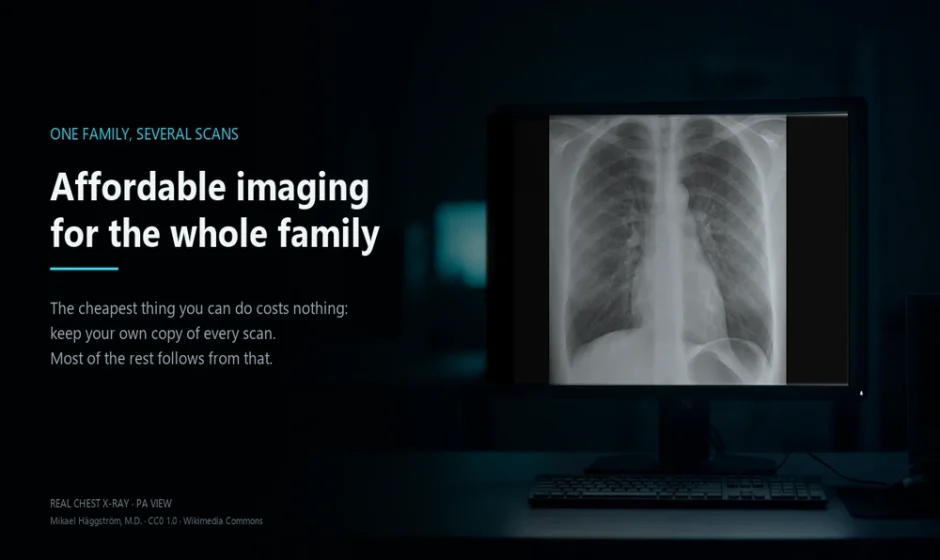

Imaging tends to arrive in clusters. A parent has a knee scanned, then has it scanned again eighteen months later to see whether anything has changed. A child falls off something and gets a head CT at two in the morning. An older relative starts a series of follow-ups that will run for years. Within a single household, and often within a single year, a family can accumulate a surprising number of studies – across different hospitals, on different systems, with reports written in a language none of them speak.
The costs that hurt in that situation are rarely the ones printed on an invoice. They are the repeat scan that happened because nobody could find the previous one, the second opinion that was priced out of reach, and the fortnight of worry between a report landing and somebody explaining it.
Most of that is avoidable, and the single most effective step costs nothing at all.
Start with the free thing that saves the most money
Get a copy of the images, every time, and keep them.
This sounds administrative. It is the highest-value habit in this entire article, and here is why: in radiology, comparison with a previous study is often more informative than the current study on its own. A finding that has been identical for four years and the same finding appearing for the first time mean completely different things, and no amount of detail in today’s images can distinguish them. When the previous scan is unavailable, the options are to repeat the imaging or to arrange follow-up simply to establish what an older file would already have proved.
That is where the money goes. A family that keeps its own copies converts a future repeat scan into a two-minute file transfer.
You are generally entitled to those images. In the United States, the right to obtain a copy of your own medical records – imaging included – is set out by the federal government, and HealthIT.gov explains how to request them. In the UK and across Europe, equivalent access rights apply. Ask at the department on the day of the scan, when it is a routine request, rather than months later when it becomes a formal one.
Ask specifically for the images, not only the report. They are different things, they are stored separately, and the images are the part that prevents the repeat.
What it costs to actually open them: nothing
Hospital discs and USB sticks hold files in a format called DICOM, the international standard for medical images. The folder usually looks like nonsense: no obvious file extensions, cryptic directory names, and viewer software bundled on the disc that is Windows-only, elderly, and frequently refuses to run at all.
You do not need that software. Several browser-based DICOM viewers are free and will open the folder directly. The important thing to check is whether the tool processes the files on your own device rather than uploading them – the good ones say so explicitly, and for a family archive that distinction matters more than any feature.
Drag the whole folder in. You do not need to work out which file matters.
Free, authoritative places to understand what the report says
Before paying anyone to explain a report, it is worth knowing how much high-quality explanation is already free. These are the sources clinicians themselves point patients towards:
- RadiologyInfo.org – run jointly by the American College of Radiology and the Radiological Society of North America. Plain-language pages on essentially every imaging test, written for patients rather than clinicians.
- MedlinePlus, from the US National Library of Medicine – short, reliable, and free of any commercial interest.
- The NHS pages on MRI and CT – concise, and useful wherever you live.
What these cover well is the test: what it looks at, how it is done, what it can and cannot show. What they cannot do is tell you what the particular sentence on your particular report means, which is usually the thing keeping someone awake.
Where paid analysis fits, and what it is not
A formal second opinion – another radiologist re-reading the study and putting their name to an interpretation – is the gold standard, and for a genuinely contested finding it is what you want. Most health systems will arrange one on request. It is also the most expensive option, it is frequently not covered, and for a family with several exams the cost multiplies quickly.
Between free reading and a paid radiologist sits a newer category: AI tools that translate report language into plain words and, in some cases, read the images themselves. Prices are typically per exam and an order of magnitude below a professional second read, which is what makes them relevant when there is more than one study to deal with. Tools in this space include Read Your Scan, among others.
Being clear about what this category is not matters more than the price:
- It is not a diagnosis and nobody licensed has signed it. A radiologist’s report carries professional accountability. An AI explanation carries none.
- It has not seen your previous scans unless you supply them – which is another argument for keeping the archive.
- It has not examined anyone. A finding on an image and a symptom in a person are different things, and imaging alone cannot connect them.
- It can be wrong with complete confidence. These systems do not signal uncertainty the way a person does.
Used well, the value is not an answer. It is walking into an appointment able to ask a specific question instead of a vague one – which is a better ten minutes for everybody in the room.
The cheapest scan is the one nobody needed
For families managing several exams, the largest saving available is usually not a discount. It is a scan that never happens because it would not have changed anything.
This is not a fringe view. Choosing Wisely, a campaign run with specialist medical societies, exists specifically to identify tests that are commonly ordered and frequently unnecessary – imaging for uncomplicated low back pain in the first weeks being among the most cited examples. Radiologists themselves maintain the ACR Appropriateness Criteria, which rank imaging options for a given clinical situation.
None of that means declining imaging your doctor recommends. It means one question is legitimate and worth asking: what would we do differently depending on the result? If the honest answer is nothing, that is a conversation worth having before the appointment is booked rather than after the bill arrives.
If there are children in the household
Children are not small adults where imaging is concerned. They are more sensitive to radiation and have more years ahead in which any effect could matter, which is why paediatric protocols use lower doses and why the choice of test is weighed differently.
Image Gently is an alliance of radiology and paediatric organisations devoted to exactly this, and its materials are written for parents as well as clinicians. Its adult counterpart is Image Wisely. Both are free, neither is selling anything.
Worth knowing: MRI and ultrasound use no ionising radiation at all. Where either can answer the question, radiation stops being part of the calculation – and for a child having repeated follow-up imaging, that is a reasonable thing to raise.
A filing system that takes ten minutes to set up
None of the above works without somewhere to put things. For a household tracking several people and several years, this is enough:
- One folder per person, one subfolder per exam, named with the date first and the body part second – 2026-03-14-knee-mri. Dates sort themselves and a radiologist’s first question is when.
- Keep the images and the report together. They arrive separately and get separated permanently unless you file them as a pair.
- Back it up somewhere that is not one laptop. These files are hard to replace years later and hospitals do not keep them forever.
- Keep a one-line index – who, when, which body part, which hospital. This is the document you will actually use at an appointment, and it takes seconds per entry.
- Note that scan files carry identifying details – name, date of birth, hospital ID – inside the files themselves. Treat the archive the way you would treat passports.
Frequently asked questions
Can I be charged for a copy of my own scans?
Rules vary, but a reasonable cost-based fee for the media is generally the most that applies, and many departments now provide a download link at no charge. Asking on the day of the scan is usually simpler and cheaper than requesting months afterwards.
Is it worth getting a second opinion on every scan?
No, and for a family managing several exams that would be unaffordable as well as unnecessary. A second read earns its cost when a finding is genuinely ambiguous, when a major decision such as surgery rests on it, or when the report does not fit the symptoms. For everything else, the previous scan and a conversation with your doctor answer more for less.
How long should we keep old scans?
Indefinitely, because storage is cheap and their value increases with age. A twenty-year-old image proving a finding has not changed is worth more than a new scan showing the same thing today. Hospitals have retention limits; your own archive does not have to.
Is it safe to upload family scans to an online tool?
It depends entirely on the tool. Scan files contain identifying information in their metadata, so use one that removes it before anything is transmitted and states plainly what it stores. Tools that process images in your browser never transmit them at all, which for a household archive is the safer default.
Our reports come from different hospitals. Does that matter?
For comparison it matters a great deal, and it is one of the most common reasons imaging gets repeated. Systems frequently cannot see each other’s archives. A family that carries its own copies removes that problem entirely, and it is the single most useful thing to bring to a first appointment with a new specialist.
The short version
Affordability in medical imaging is mostly not about finding cheaper analysis. It is about not paying twice.
Keep your own copies, and the repeat scans stop. Use the free, authoritative sources first, and much of the confusion resolves before anyone spends anything. Where you do pay, know what you are buying: a plain-language explanation is a real and modestly priced service, and a licensed second opinion is a different and more expensive one. Neither replaces the doctor who can examine the person the scan belongs to.
This article is for general information. It is not medical advice, a diagnosis, or a substitute for a doctor or radiologist. If you or a family member has urgent symptoms, seek care. Some tools mentioned are commercial products; the free resources linked here are maintained by medical societies and public health bodies.